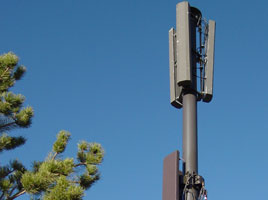
The local wireless network landscape in the Reno/Sparks area has seen several notable shifts, site activations, and structural changes in the past year. They include:
Network Shutdown & Spectrum Sale
Boost Mobile / Dish Wireless Decommissioned: The 4th major U.S. carrier – Boost Mobile / Dish Wireless – officially decommissioned its network on October 31, 2025. Its 45 local macro cell sites were shut down, and its radio licenses and spectrum are being sold to AT&T and SpaceX.
Macro Site Leaderboard & Midband 5G Expansion
The carrier leaderboard for active macro sites and 5G midband upgrades shows the following breakdown:
Verizon Wireless:
84 active macro sites and 5 active small cells.
72 sites (86%) have been upgraded with 5GUW midband spectrum (n77).
T-Mobile:
71 active macro sites.
65 sites (92%) are upgraded to 5GUC midband spectrum (n41), giving T-Mobile the highest percentage of upgraded midband sites in the area.
AT&T:
62 active macro sites and 15 active small cells.
47 sites (76%) are upgraded to 5G+ C-Band spectrum (n77).
All 3 carriers have known plans to expand their 5G network with Verizon leading the way, followed by T-Mobile and AT&T.
Recent New Cell Site Deployments
Carriers have continued expanding coverage across the Truckee Meadows, heavily relying on co-locating antennas on existing structures and towers:
AT&T:
September 1, 2026: Activated a new site co-located with Verizon on Design Place in northwest Spanish Springs.
August 1, 2025: Activated a site co-located with Verizon on a faux water tower at the Arrowcreek Golf Course in rural southwest Reno.
T-Mobile:
January 7, 2026: Activated a site co-located with Verizon and AT&T behind the Reno Fire Station at Veterans Pkwy & Steamboat Pkwy.
October 8, 2025: Added a co-location with Verizon on Pacific Avenue in Sparks (southwest of I-80 & Rock Blvd).
September 30, 2025: Added a co-location with AT&T near Cold Springs Middle School.
May 8, 2025: Activated a site on Lakeside Drive near Bartley Ranch Rd.
Verizon:
September 19, 2024: Added a new cell site on Bennie Lane near US-395 & Parr Blvd, co-located on a monopole with T-Mobile.
There are new cell sites in the planning and construction stages lead by T-Mobile, followed by Verizon with an approved site at North Valleys High School.
Deployed Download Bandwidth (Washoe County)
In terms of total deployed download bandwidth across low-band, mid-band, and 3 GHz TDD frequencies, the carrier totals stand as follows:
T-Mobile: 270 MHz total
Verizon: 255 MHz total (excluding low-power 3.6 GHz CBRS spectrum used at select sites)
In late 2023, AT&T began notifying internet customers in the Reno area that are not currently eligible for Fiber Internet, about the availability of AT&T Internet Air. The targeted customers include subscribers to DSL and former “U-verse” branded Internet service.
Therefore, before acting upon AT&Ts offer to “upgrade” your service, for best results make sure that you live near a cell site that’s been upgraded to 5G+. Also it is suggested to perform some speed tests near various windows around your home to check download, upload and latency speeds – and compare with your current internet service.
This chart will be regularly updated to show the Reno area wireless carrier’s number of active cell sites, sites under construction (U.C.) and sites in the planning or permitting process (P/P). The chart also includes small cell (SC) sites and outdoor distributed antennas systems. Numbers reflect sites serving the Truckee Meadows – Reno/Sparks city limits, and unincorporated areas in-between (such as Saddlehorn, Mogul and Sun Valley).
Wireless Carrier
Macros Active
Macros U.C.
Macros P/P
SC Active
SC U.C.
SC P/P
AT&T
62
0
0
15
0
3
Boost Mobile / Dish Wireless (Decommissioned Oct 2025)
45
0
0
0
0
0
T-Mobile
71
1
5
0
0
0
Verizon
84
0
1
5
0
12
Legend: U.C. = Under Construction, P/P = Planning/Permitting (activity within past few years), SC = Small Cell/oDAS
Upgraded 5G+/UW/UC midband sites
Upgraded 5G midband macro sites with 5G+ (AT&T n77), Ultra Wideband “5GUW” (Verizon n77) or Ultra Capacity “5GUC” (T-Mobile n41). These sites have much more bandwidth enabling more simultaneous users and data speed availability of 1 Gbps or more. These sites also allow home internet Fixed Wireless Access (FWA) to be offered in the area.
Massive MIMO (Multiple Input, Multiple Output) panel antennas noted above with the red arrows, are used with midband frequencies and high bandwidth to help allow more simultaneous users and data speeds of 1 Gbps or more. This cell site is located on E 7th St & Montello St in Reno.
Download bandwidth by carrier in Washoe County
Carrier
Deployed Total Download Bandwidth (Low band FDD + mid band FDD + mid band TDD + 3 GHz TDD)*
AT&T
35 (LB-FDD) +50 (MB-FDD) +140 (3G-TDD) = 225 MHz
Dish
10+45+0+0=55 MHz
T-Mobile
25 (LB FDD) +55 (MB-FDD) +190 (MB-TDD) = 270 MHz
Verizon
20 (LB FDD) +35 (MB-FDD) +200 (3G-TDD)* = 255 MHz
*Excluding the low-power 3.6 GHz CBRS band, which Verizon typically uses up to 60 MHz of bandwidth in the Reno area on some sites upgraded between March 2023 and August 2024.
Data used for these tables is derived from on-location cell site observations, user reports and public records.
Verizon Wireless recently completed coverage improvements along the Mt. Rose Highway stretching from Wedge Parkway in Reno on the east, to Tahoe Meadows near the Mt. Rose summit on the west. Improvements in the past year include the installation of 4 new cell sites along the Mt. Rose Highway corridor and improvements to an existing cell site atop Slide Mountain.
New cell sites include:
Sky Tavern ski area (at the summit)
New site serving the Saddlehorn/Arrowcreek/Whites Creek area
Mt Rose Hwy & Wedge Pkwy
NDF Galena Fire Station – new taller monopine with room for 3 carriers replacing existing monopine.
New monopine on distant/right with Verizon Wireless and AT&T antennas. T-Mobile will locate on the bottom position.
On July 25, 2018 the Reno City Council moved forward to allow the installation of small cells on city owned street lights. The agreements with AT&T, Verizon and ExteNet Systems, Inc. are projected to allow the installation of 100 small cell sites in the first year of deployment, and up to 5000 locations after 5 years. Additionally over 150 miles of fiber optic cable will be installed to support the small cells.
Some differences between a small cell and the more common “macro cell” are the size of antennas and equipment, and the range. While a macro cell will typically service a range of one to several miles with multiple directional antennas as large as 8 feet tall, a small cells range is typically no more than 1/4 mile with antennas just a few feet tall and hidden inside a shroud atop a street light or other tall pole.
A small cell pictured here was constructed in mid-2018 on an existing street light at the corner of Evans Avenue and Enterprise Road in Reno, and served as a demonstration of what future small cells would look like.
Edited 11/8/18 to correct that the small cell shown in the picture was a non-operational demonstration of the what small cells would look like.
Do you have poor wireless cell coverage at home due to wireless carriers having trouble locating their cellular transmission antennas, towers and poles in residential neighborhoods? Resident complaints that cell towers will decrease property values or become eyesores within the landscape have persuaded elected officials to deny the permits needed to construct new cell sites.
Fortunately there are a few solutions that will improve wireless cell coverage within the home or other small-to-medium size buildings where coverage is weak. All four major U.S. wireless carriers now offer Wi-Fi Calling, which is available on many of the latest smartphones. Alternatively, the carriers also offer a small device that connects to your home broadband internet connection technically called a “femtocell” – which improves the wireless signal to cell phones located nearby. Each carrier has their own branded femtocell – links for the individual carrier’s femtocell offerings follow:
Wi-Fi Calling can be a better alternative – it uses the existing wi-fi connection in your home to connect your phone to the wireless cellular network through your home broadband internet connection. When connected, calls and text messages will typically be as clear and reliable as your wi-fi connection. Check with your carrier and/or smartphone manufacturer for instructions on how to setup Wi-Fi Calling.
The advantage of Wi-Fi Calling vs. getting a femtocell is that if you have a compatible smartphone and a Wi-Fi router, there is no extra cost to setup Wi-Fi Calling. A femtocell can cost up to a few hundred dollars, however carriers will sometimes discount or fully subsidize the cost for the device for their more profitable customers.
Verizon has launched three new cell sites since July and relocated one due to road construction. The new sites include:
Lemmon Valley – next to the water tower off Patrician Drive
Wooster High School – replacing one off the light poles on the football field
Summit Mall – a monopine located at a self-storage facility behind the mall
In Sparks, a cell site near Pyramid Way and Queen Way was relocated to a new church tower to the east due to the construction and widening of Pyramid Way.
Verizon Wireless continues to outpace other wireless carriers in the construction of new cell sites in the Reno area. Since February 2015, Verizon has added 4 new cell sites:
McCarran & Neil – atop the office building across from Meadowood Mall
East Lincoln & Howard, Sparks – a monopole near the Sparks Marina
Greenbrae Shopping Center, Sparks – a monopine behind the Post Office
Las Brisas Blvd. near N. McCarran – a monopine near the NV Energy power substation
Verizon currently has at least 7 additional cell sites in the planning, permitting or construction process.
T-Mobile has added a new cell site near South Virginia Street & Patriot Blvd. The site is co-located on an existing monopole which is also occupied by Sprint.
Reno ranks 124th of the most populous 125 metro areas in the United States in testing of overall mobile network performance according to a recent RootMetrics report.
Data for the Reno metro area only shows a virtual three-way tie between T-Mobile, Verizon and AT&T for overall network performance. Individual tests of Network Reliability, Call and Text are virtually tied between the 4 major carriers which include Sprint. According to the report Verizon is the Award winner in terms of Network speed and Data, while Sprint falls short of the other 3 carriers in those categories.